Our Canoeing Heritage

 The word "canoa" or "canoe" appeared in the earliest writings about the First Peoples of the New World, and was adapted from the Arawak language of the Native Caribbeans. While the word simply referred to a boat or vessel in its original meaning, it has largely come to refer to a specific craft which is familiar to many people today. The word "canoa" or "canoe" appeared in the earliest writings about the First Peoples of the New World, and was adapted from the Arawak language of the Native Caribbeans. While the word simply referred to a boat or vessel in its original meaning, it has largely come to refer to a specific craft which is familiar to many people today.
However, there is an ancient and rich diversity in canoe shapes, construction and purpose, a knowledge that Native builders have refined over the past centuries. Some canoes were elegantly carved and formed from the massive trees of the northern Pacific coast for trade, war and for hunting the great whales. Other builders carved smaller canoes, well suited for travelling rivers, creeks and small waterways. In the harsh treeless Arctic landscape, the generosity of the ocean and rivers provided Inuit builders with animals and driftwood, from which they perfected the seaworthy shapes of their covered hunting craft.
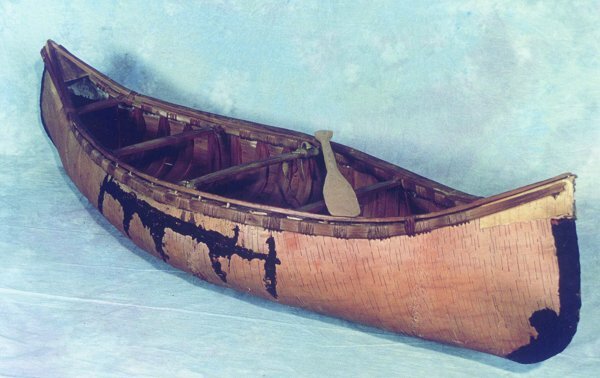
Birch bark canoe
|
Throughout much of the rest of Canada, the rind of the White Birch tree helped Native builders to overcome the challenges of overland and coastal travel. Builders of bark canoes removed the supple skin from these trees, tailored them into carefully proportioned vessels of their own traditions, and lined the entire craft with a lightweight wooden frame. In a land crisscrossed by a myriad of rivers and creeks, the birch bark canoe provided the traveller with a craft that could carry a great load, was light enough to be carried as the need arose, and which could manage the rigours of early travel.
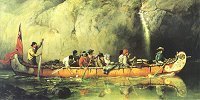
"Voyageurs" by Frances Anne Hopkins (1838-1919)
|
Early 18th-century commercial interests demanded that Europeans venture deeper into the North American continent, where they discovered extensive Aboriginal trade networks already in place along established canoe routes. Moreover, they found that their own heavy boats were not suitable for plying the lakes, rivers and portages. Knowledgeable river guides and canoe builders were engaged to support their own expanding trade relations. Perhaps the most celebrated figure of this early commerce was the voyageur: that colourful paddler who remains enshrined beside the birch bark canoe in Canadian folklore today. By the late eighteenth century, large bark canoes paddled by voyageurs and used for distance transport had connected the businesses of the St. Lawrence valley with the Mississippi, as well as the western and northern reaches of the continent.
|
|
|
|
Wednesday, June 22, 2005
The Museum houses the largest collection of canoes and kayaks in the world, featuring over 600 watercraft.
The Canoe: A Canadian Icon
Canada exists because of the canoe. The canoe determined national boundaries and carried sovereignty to the northern half of the continent. Long before the arrival of Europeans in the Western Hemisphere, the canoe was at the centre of Aboriginal life and was the principal means of trade and communication between First Nations.
It was the symbol of a frontier perhaps unique in the world, on which a canoe-based trading partnership (between Europeans and Native peoples) emerged that created Canada, and equally importantly, established principles of mutual respect and accommodation, not dispossession.
Though these principles were badly eroded on the later frontier of settlement, the basis had been established during the era of the canoe for Canada's later reputation of understanding between peoples. The canoe is a symbol that joins British and French in the creation of Canada and puts the French at the centre of national development. And it is the most powerful symbol Canada has of the cooperation between Europeans and Aboriginal Peoples in Canada's early economic development. In the fur trade can be found the roots of multiculturalism.
|
|